How we got here
In 1954, the county created the Delaware County Incinerator Authority to oversee three incinerators that operated here from the late 1950s through 1979, when they closed.
Two of them were transformed into transfer stations, one in Chester Township and another in Marple Township.
Read more here by local reporter, Kathleen E. Carey, “Trash-disposal crisis means consumers will pay more,” Delaware County Times, Jan. 27, 2019. https://www.delcotimes.com/news/local/trash-disposal-crisis-means-consumers-will-pay-more/article_026449cc-1ffb-11e9-a809-4798edf4e0cd.html
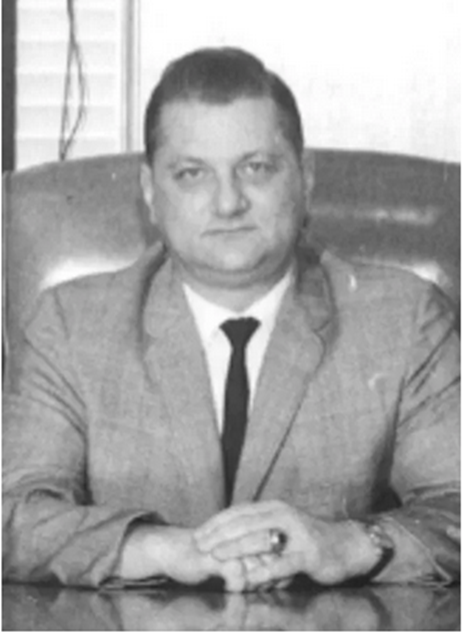
In the late 1980s, former Chester City mayor John “Jack” Nacrelli, convicted racketeer and organized crime boss, controlled Chester City after his prison term and turned Chester City Council away from the city’s proposed waste project and got them to back a Delaware County plan to build the incinerator in Chester.
Bribes and threats were made, and unusually large fees were paid to the underwriters and special counsel for the city to arrange the deal.
A host community agreement was signed by the City of Chester in January 1989. The incinerator started operating in 1991.
Read more: “Organized Crime in Pennsylvania: A Decade of Change – 1990 Report,” Pennsylvania Crime Commission, pp. 317-18. https://www.ojp.gov/pdffiles1/Digitization/133208NCJRS.pdf
An incinerator ash dump planned for an abandoned quarry off of Township Line Road was defeated by local opposition.
1984: The Delaware County Incinerator Authority bought the Colebrookdale Landfill in Earl Township, Berks County at the direction of county council.
1985: The Delaware County Incinerator Authority was renamed the Delaware County Solid Waste Authority (DCSWA).
1998: The landfill was renamed Rolling Hills Landfill.
Read more by local reporter, Kathleen E. Carey, “Trash-disposal crisis means consumers will pay more,” Delaware County Times, Jan. 27, 2019. https://www.delcotimes.com/news/local/trash-disposal-crisis-means-consumers-will-pay-more/article_026449cc-1ffb-11e9-a809-4798edf4e0cd.html; Ash landfill location: https://static1.squarespace.com/static/5a858efeace8645cabb72cde/t/5ae4490a1ae6cfa83d236fa8/1524910346748/Arata-Larry-5th-District-Candidate-Questionnaire.pdf
Delaware County Solid Waste Authority (DCSWA)
The county established this authority to oversee solid waste processing in the county. As part of establishing the authority, Covanta was granted a contract that includes:
- Promises to provide at least 300,000 tons/year of DelCo trash to burn at Covanta in Chester or DCSWA has to pay Covanta, anyway (“put or pay”).
- “Put or pay” clauses that punish waste reduction. If the county reduces waste by more than about 20%, it must pay Covanta to not use them.
- Provides the right to dump up to 450,000 tons/year of incinerator ash at DCSWA’s Rolling Hills Landfill.
- A discount to Chester City, home of the incinerator and recipient of the burning process residuals (truck traffic, air quality reductions, reduced home values, etc.)in exchange for extra cheap ash dumping at the county’s landfill.
Delco has been sending an average of 360,000 tons/year to Covanta from 2016-2020, though crossed a contract threshold of 370,000 tons in 2020 for the first time (due to pandemic), sending 380,000 tons and having to pay a higher rate for the excess 10,000 tons.
From 2005-2015, Covanta brought in between 500-600K tons/year of incinerator ash from Chester, Plymouth and their incinerators in NJ, but has averaged 451,000 tons/year from 2016-2020.
This “ash for cash” deal is why DCSWA is waiting for DEP approval of their landfill expansion before negotiating a new contract with Covanta.
Where our waste goes
As of 2020 (the total doesn’t change much year to year), here is a breakdown of where trash goes in Delco:
| Incinerator or Landfill | County | Tons | % |
| Covanta Delaware Valley (1) | Delaware | 380,123 | 81% |
| Fairless Landfill | Bucks | 81,275 | 17% |
| Covanta Plymouth Renewable Energy (1) | Montgomery | 5,032 | 1% |
| DCSWA – Rolling Hills Landfill (2) | Berks | 1,187 | 0% |
| Pioneer Crossing Landfill | Berks | 139 | 0% |
| Chester County SWA Lanchester Landfill | Chester | 14 | 0% |
(2) This is owned by DCSWA
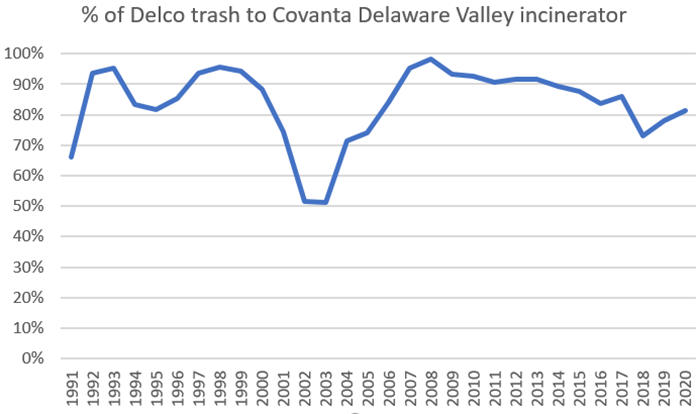
The percentage of Delco trash going to Covanta Delaware Valley has varied a lot, from 51% to 98%.
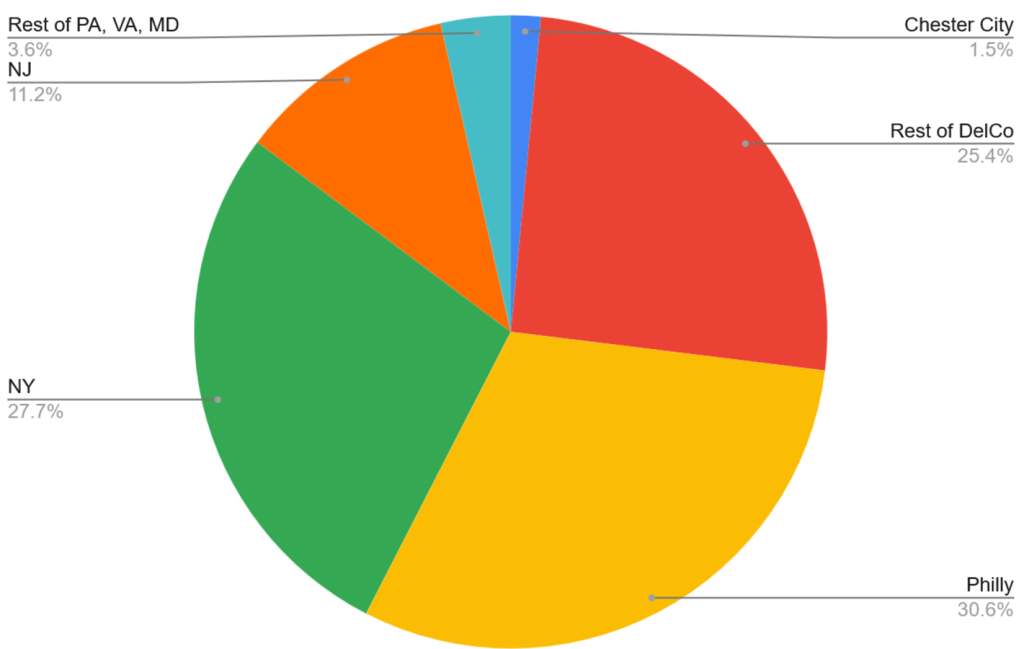
Where waste burned in Delco comes from
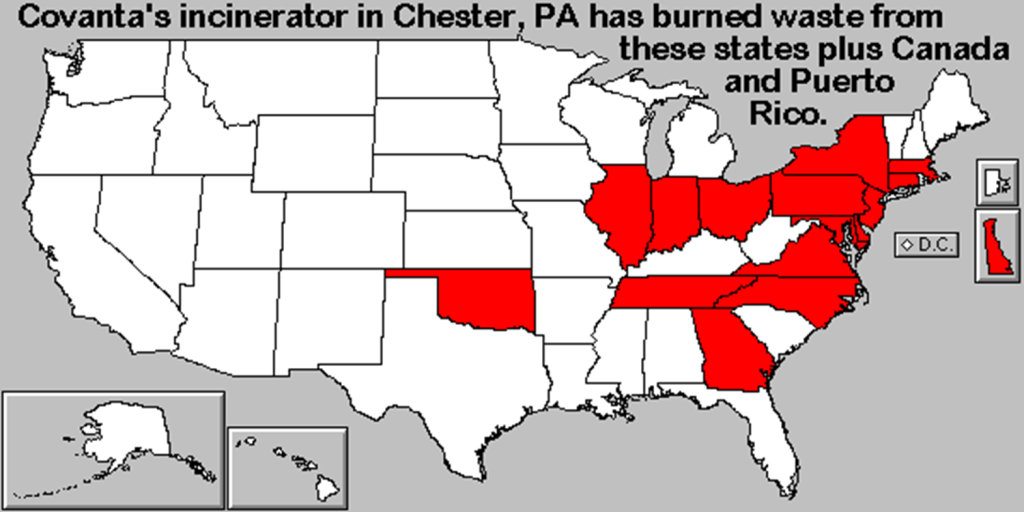
Waste burned by Reworld (Covanta) comes from 14 states plus Canada and Puerto Rico.
Here are the counties in PA that send their waste to Reworld:
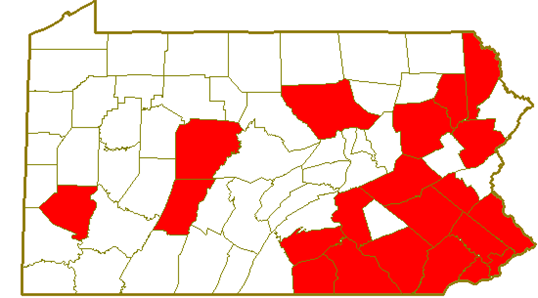
Source: PA Dept of Environmental Protection http://cedatareporting.pa.gov/reports/powerbi/Public/DEP/WM/PBI/Solid_Waste_Disposal_Information
And here are the amounts as of 2020:
| 31% | Philadelphia City, PA |
| 31% | Delaware County, PA |
| 17% | DE (rerouted NYC trash) |
| 16% | NJ |
| 4% | NY |
| 2% | Ocean City, MD |
| 0.2% | 4 other PA Counties |
| 0.01% | VA |
| 0.003% | NC |
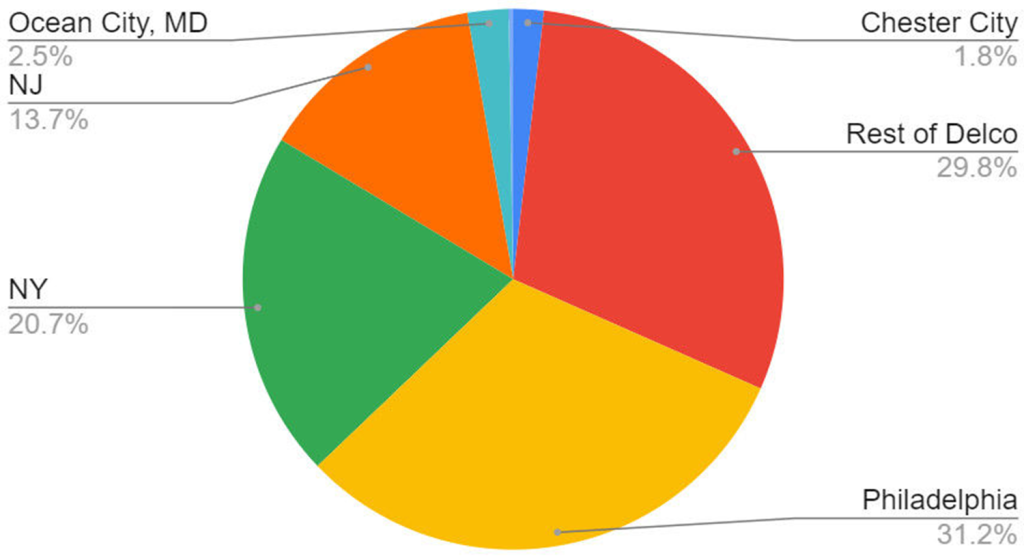
Here is the 2021 data, as well:
And for 2024:
DCSWA’s Rolling Hill’s Landfill
Waste going to the landfill comes from many sources, as well.
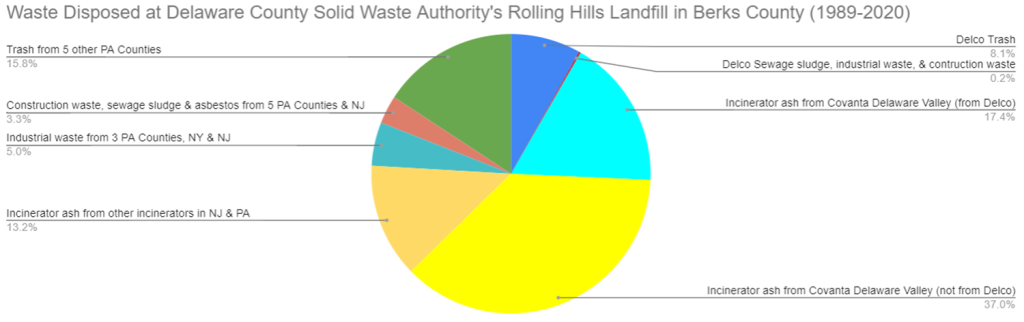
Only 26% of the waste in Delco’s landfill is from Delco – this is highly unusual!
74% is from other counties and states, including biomass incinerator ash from Reading and sewage sludge incinerator ash from Passaic County, NJ.
The landfill was projected to be filled by October 2022 if not expanded.
One (vertical) expansion is pending DEP approval, which could buy up to 10 years of space under status quo disposal rates.
Rolling Hills Landfill is run like a private facility
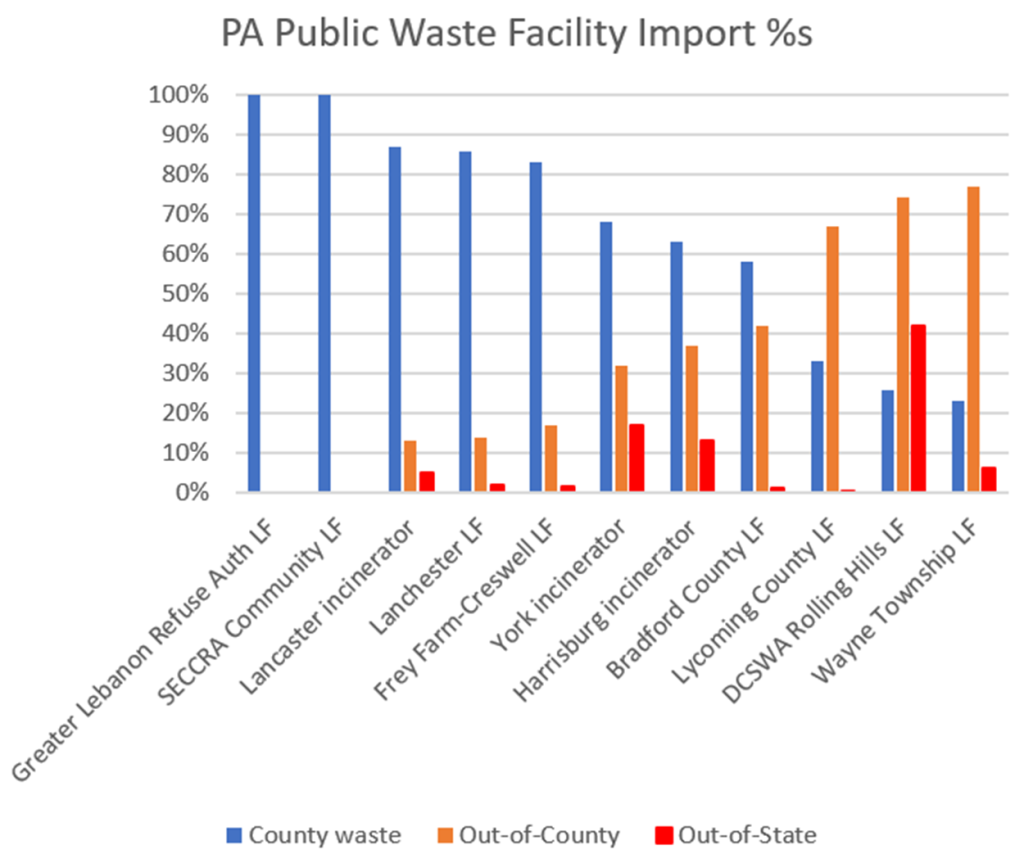
Publicly-owned waste facilities (usually owned by counties or regional authorities) tend to primarily, or only, take waste from within their county/region, conserving space for future use.
Privately-owned waste facilities tend to import as much as possible to maximize profits.
Pennsylvania is the largest importer of trash, in part because so many landfills have been privatized.
Since 1988, 40% of the waste dumped and burned in PA has been from out-of-state. This is done at mainly private facilities.
DCSWA has managed Rolling Hills Landfill like a private waste facility, giving away nearly three quarters of the space to out-of-county and out-of-state dumpers.
Indeed, Rolling Hills Landfill imports more out-of-state waste (42%) than any public waste facility in PA, and higher than the state average of 40%. Of the public waste facilities in PA, they’re second in out-of-county waste, at 74%.
We need to work to fix this, so Keep Reading!