
Where would our waste go if we don’t burn it in Chester?
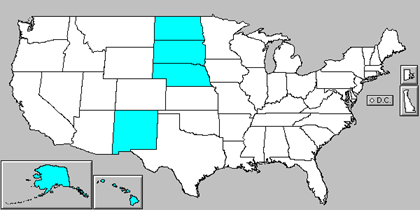
- Pennsylvania has a problem with TOO MUCH landfill space, making the state a magnet for dumping.
- Pennsylvania has been the nation’s #1 importer of trash since it was first studied in the early 1990s, accepting trash from 44 states, DC, Puerto Rico, the Virgin Islands, Bermuda, and Canada.
- Pennsylvania has 43 landfills and six trash incinerators.
- DCSWA owns a landfill in Berks County, where three more private landfills also operate.
Sources: PA Department of Environmental Protection, Municipal Waste Landfills and Resource Recovery Facilities: https://www.dep.pa.gov/Business/Land/Waste/SolidWaste/MunicipalWaste/MunicipalWastePermitting/Pages/MW-Landfills-and-Resource-Recovery-Facilities.aspx; Solid waste disposal information database: http://cedatareporting.pa.gov/reports/powerbi/Public/DEP/WM/PBI/Solid_Waste_Disposal_Information
Congressional Research Service reports on interstate shipment of municipal waste are available at http://www.actionpa.org/waste/
Landfills in our Region
Once the Delaware County Solid Waste Authority’s Rolling Hills Landfill (in red) runs out of space, there is no shortage of nearby landfills that could be used.
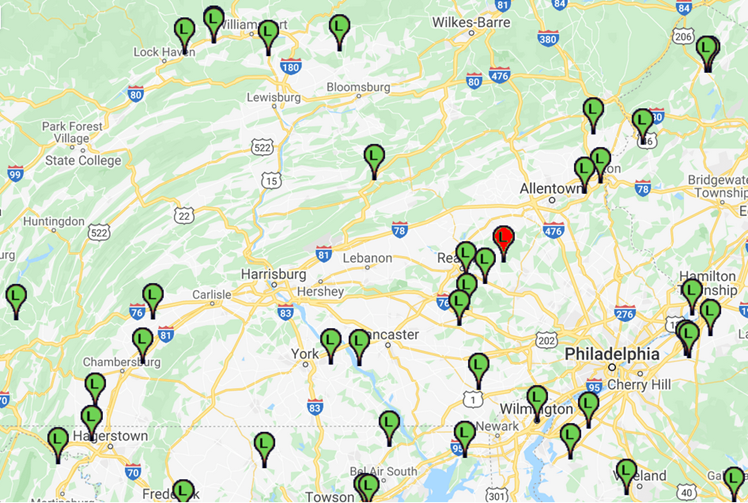
PA Department of Environmental Protection, Municipal Waste Landfills and Resource Recovery Facilities: https://www.dep.pa.gov/Business/Land/Waste/SolidWaste/MunicipalWaste/MunicipalWastePermitting/Pages/MW-Landfills-and-Resource-Recovery-Facilities.aspx
Is there time to switch away from incineration so quickly?
The county has its own landfill, and plenty of others are available. At the end of the current contract with Covanta (4/30/2022), DCSWA could use private waste haulers to bring trash from their two transfer stations to any assortment of landfills rather than to Covanta. DCSWA already has relationships with private waste haulers who have the means.
DCSWA should issue a request for proposals (RFP) for long-term hauling to landfills (its own, then others) to find favorable pricing.
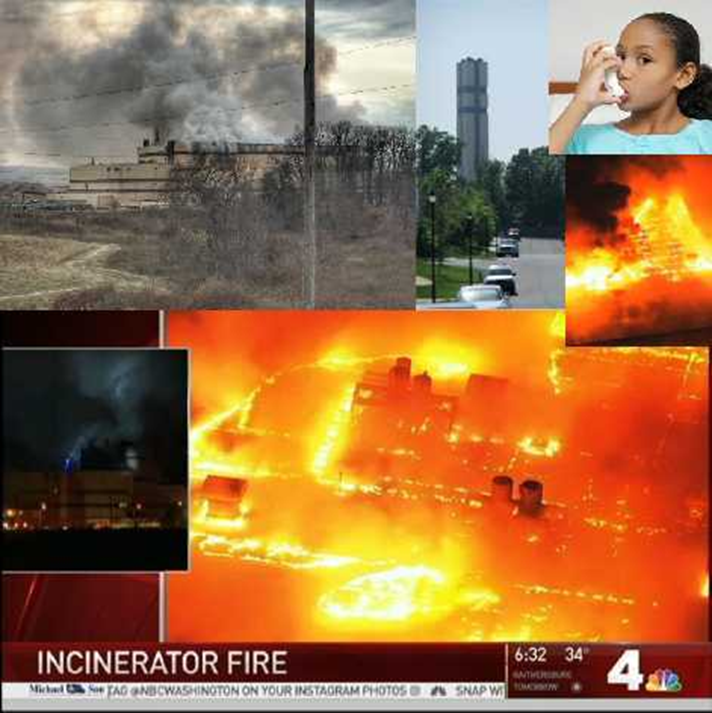
Other communities such as Detroit, MI, Hartford, CT, and Lorton, VA (pictured above) have large incinerators that abruptly and unexpectedly closed in recent years, and alternative arrangements were made to use landfills. Delco has much more time.
If Delco stops sending trash to the incinerator, won’t Reworld just replace it with other people’s trash?
In 2020, Delaware County waste was 31% of the waste Reworld burned. If Delco pulls out, there is no comparable jurisdiction with 380,000 tons/year of waste seeking a home.
- New York: already in a 20-30 year Reworld contract; unlikely to increase incineration
- Philadelphia: already in a 7-year Reworld contract and likely to stop using incinerators as of 7/1/2026
- Baltimore: in middle of a 10-year contract with their own incinerator; political commitments to stop using incineration after 2031
- Washington, DC: uses another Reworld incinerator and shortened their contract with Covanta in response to political resistance to incineration
It’s unlikely that Reworld will easily fill that gap with waste from elsewhere. If Philadelphia pulls out their 31% when their contract is up next, that’s close to half of the incinerator’s waste supply gone, and not easily replaced unless Reworld closes other incinerators of theirs.
In 2014, Reworld burned 158,893 tons less than they did in 2017. They managed to fill a big gap with New York City trash, but burned at much lower levels for several years until landing that contract. Without a new source of waste over twice as large as that gap, Reworld will not easily replace Delco trash. They will have to burn less, which is the quickest path to reducing Reworld’s pollution.
Will ending the county’s contract shut Reworld down?
No one has made this claim. Some DCSWA board members have misrepresented advocates’ statements by stating that this is the claim, but it’s a straw man argument.
A broad range of Delco residents and organizations share the goal of closing Reworld, but we are not claiming that cutting off 31% of their waste stream is sufficient to close Reworld. It might, however, lead to their curtailing the use of 1-2 of their six burners.
Ending Delco’s use of incineration could have immediate public health and environmental benefits, however, reducing air pollution more quickly than any effort to install missing pollution controls.
Ending Delco’s use of incineration will also help inspire other jurisdictions to do the same, and could be a first step toward closing the incinerator.
Isn’t it better to contract with Reworld and force them to install state-of-the-art pollution controls?
Reworld will not install missing controls until forced to. That’s why they got away with missing 2 of 4 control systems for three decades (even after EPA inspectors questioned it in 2011) until DEP forced them to install NOx controls. New controls take several years to design, permit and install and would be a costly investment for a 30-year old plant. Even with modern pollution controls, they’d still be the leading air polluter in the county.
In Camden, NJ, where Reworld owns an incinerator that is the largest air polluter in Camden County, they have proposed to install the baghouse filter system they never had to capture particulate matter. They’ve stated that this will take about three years to install once they obtain the needed state permits – one year for each of three boiler systems, as they close just one unit at a time.
In Chester, Reworld has six kilns that burn waste, and they need to design a novel system to work with their unusual type of burner. It could take a few years just to design and permit, and perhaps six more years to install, at which point the plant is so close to the end of its life that it makes little sense to make this investment.
They cannot afford to come up to modern standards, which could cost on the order of $200 million or more. Requiring this in a contract means that a new contract would have to be long-term and guarantee a minimum amount of revenue to Reworld to make it worthwhile for them. It’s not worth the dedication to that much waste and pollution when greater cuts in pollution can come right away from feeding them less waste.