Some Quick Facts
Names: Delaware Valley Resource Recovery Facility, Covanta / Reworld Delaware Valley
Address: 10 Highland Ave, Chester, PA 19013 (map)
Owners
1991 – April 1997: Waste Resource Energy Inc. (Westinghouse)
May 1997 – May 2005: American Ref-Fuel
June 2005 – April 2024: Covanta Energy
April 2024 – present: Reworld (same company; Covanta changed their name)
Descriptions:
Resource Recovery Facility (FYI, resources are destroyed; little is recovered)
Trash-to-steam (this is an improper PR term; it’s much more than steam)
Waste-to-energy (WTE) (again, an improper PR term; every ton becomes ash & air)
Energy from waste (EfW) (this is pollution, not literally turned into energy, see more)
Thermomechanical Treatment Facility (TTF) (this is Reworld’s April 2024 rebranding of incinerators)
Trash incinerator (EPA recognizes ONLY this term as meaning the same as its legal term: Municipal waste combustor)
Size:
90 MW (small for a power plant); Can burn ~3,500 tons/day (largest in U.S.)
This size is still misreported to shareholders and PA DEP as 2,688 tons/day, even though they’ve burned much more consistently since 1997.
Largest Trash Incinerators in the U.S. (by size)
No other trash incinerator in the U.S. has more than 4 boilers.
| State | City | Name | Burners | Tons/Day |
|---|---|---|---|---|
| PA | Chester | Reworld Delaware Valley | 6 | 3,510 |
| FL | St. Petersburg | Reworld Pinellas | 3 | 3,150 |
| VA | Lorton | Reworld Fairfax | 4 | 3,000 |
| HI | Honolulu | Honolulu Resource Recovery Venture (HPOWER) | 3 | 3,000 |
| NJ | Newark | Reworld Essex | 3 | 2,800 |
| MA | West Wareham | SEMASS Resource Recovery Facility | 3 | 2,700 |
| NY | Westbury | Reworld Hempstead | 3 | 2,671 |
Covanta Lacks Basic Pollution Controls
Covanta Lacks Basic Pollution Controls
Covanta’s incinerator in Chester uses the fewest pollution control devices of any incinerator in Pennsylvania and the fewest of any in their fleet of 32 remaining incinerators. (Source: March 2009 Environmental Protection Agency inspection report, available at www.ejnet.org/chester/pollutioncontrol.html)
IT LACKS:
- Selective Catalytic Reduction (SCR) or Selective Non-Catalytic Reduction (SNCR) to reduce the nitrogen oxides (NOx) that trigger asthma attacks.
- SNCR recently installed, cutting NOx from 128 ppm to ~90 ppm; SCR would be 30-40 ppm
- Carbon injection to remove additional toxic metals and dioxins.
IT HAS:
- Spray Dryer Absorber (scrubber) – injects lime to reduce acid gases, heavy metals and organic pollutants
- Fabric Filter (baghouse) – captures particulate matter (soot)
Other Pennsylvania incinerators have more/better controls:
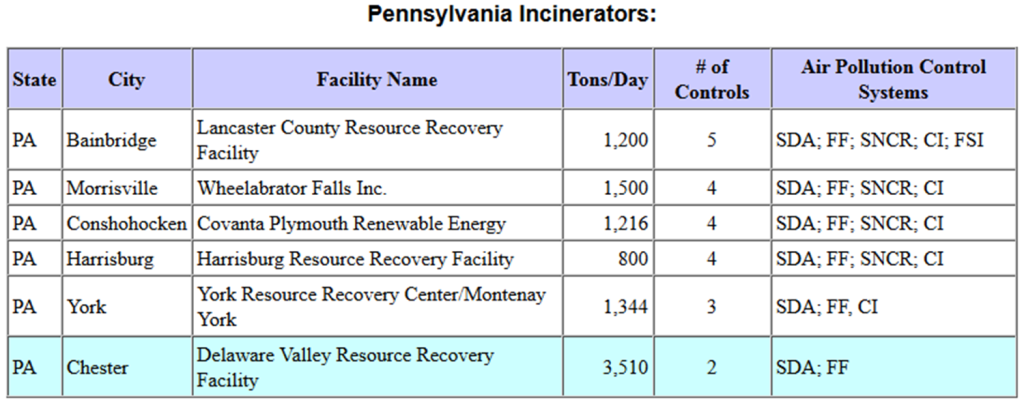
For a chart of what the air pollution control system acronyms mean, see www.ejnet.org/chester/pollutioncontrol.html
Nearly all of Covanta’s 39 incinerators have these pollution controls. Several have 5-6 pollution control devices. Chester’s has just two.
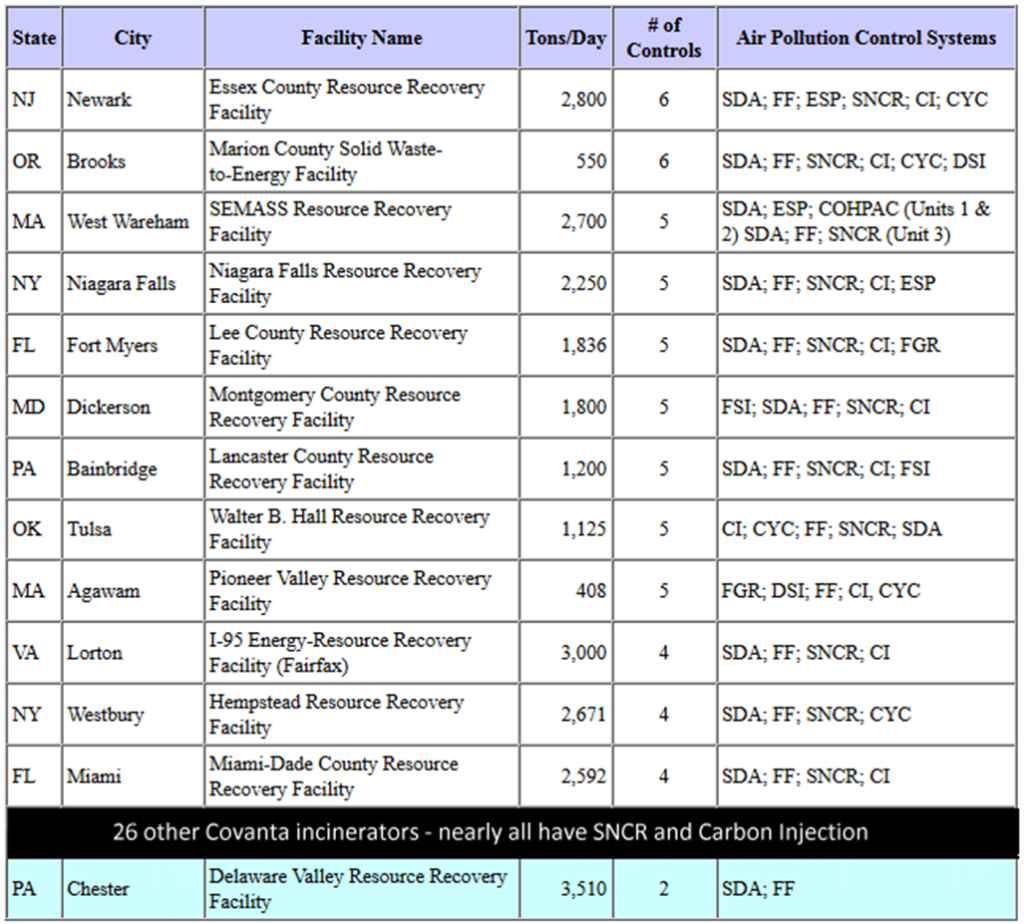
No new incinerator could be built today without these protections. Bringing this old plant to modern standards would be cost-prohibitive.
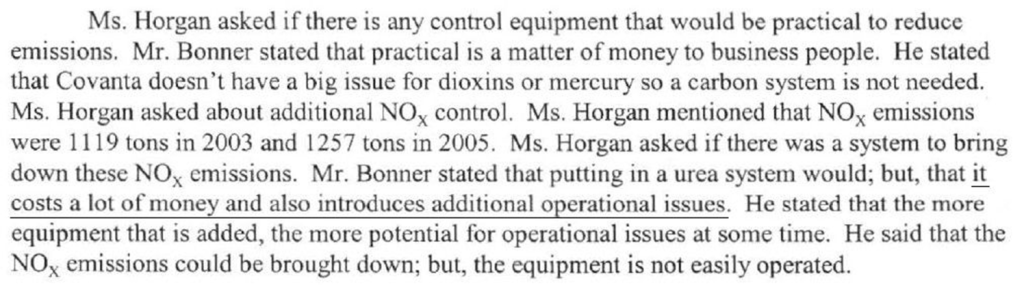
In March 2009, when an EPA inspector (Ms. Horgan) asked Covanta’s Gene Bonner why they don’t have the pollution controls that their other plants have, Covanta responded that “it costs a lot of money” and would create “operational issues.”
Covanta (now “Reworld”) is a Top Air Polluter
Their trash incinerator in Chester is the:
#1 industrial air polluter in Chester City, in Delaware County, and in the entire 7-county region surrounding Philadelphia.
All five trash incinerators in this region are among the region’s top seven industrial air polluters.
(Source: PA Department of Environmental Protection Agency Air Emissions Reports: http://cedatareporting.pa.gov/reports/powerbi/Public/DEP/AQ/PBI/Air_Emissions_Report)
Reworld Delaware Valley’s Air Emissions
| Pollutant (in pounds except CO2e) | 2022 Emissions* | Rank in DelCo | Health Effects |
|---|---|---|---|
| Global Warming Pollution (in tons of CO2 equivalents) | 914,738 | 4 | Extreme weather, disease, crop damage, species extinction |
| Nitrogen Oxides | 2,320,920 | 1 | Asthma attacks, chronic respiratory disease & stroke |
| Carbon Monoxide | 673,400 | 1 | Headaches, dizziness; increases lifetime risk of heart disease |
| Sulfur Dioxide | 392,820 | 1 | Triggers asthma attacks; chronic respiratory and heart diseases; stroke |
| Particulate Matter | 126,080 | 4 | Heart attacks, stroke, irregular heartbeat, aggravated asthma, decreased lung function, difficulty breathing |
| Hydrochloric Acid | 37,740 | 1 | Irritates eyes, skin, and nose, damages lungs |
| Fine Particulate Matter (PM2.5) | 15,140 | 5 | Same as above, but worse, gets deep into lungs and into blood stream |
| Volatile Organic Compounds | 13,700 | 15 | Eye, nose and throat irritation, headaches, loss of coordination and nausea, liver, kidney and central nervous system damage, cancer |
| Mercury | 51 | 1 | Damage to nervous, digestive, & immune systems, lowers IQ |
| Nickel | 20 | 3 | Allergy, cardiovascular and kidney diseases, lung fibrosis, lung and nasal cancer |
| Lead | 17 | 2 | Damages nervous system and kidneys, lowers IQ, increases likelihood of antisocial behavior |
| Cadmium | 5 | 2 | Kidney disease; lung cancer |
| Arsenic | 4 | 2 | Lung, skin, bladder, and liver cancers; irritation of skin and mucous membranes; affects brain and nervous system |
| Chromium (VI) | 4 | 2 | Lung cancer, shortness of breath, coughing, and wheezing |
Covanta vs. DELCORA
There are two major polluters in Chester.
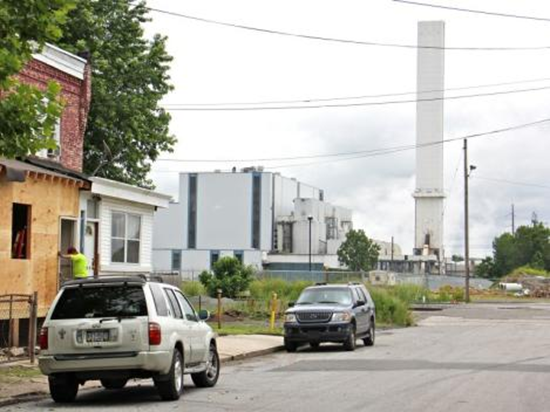
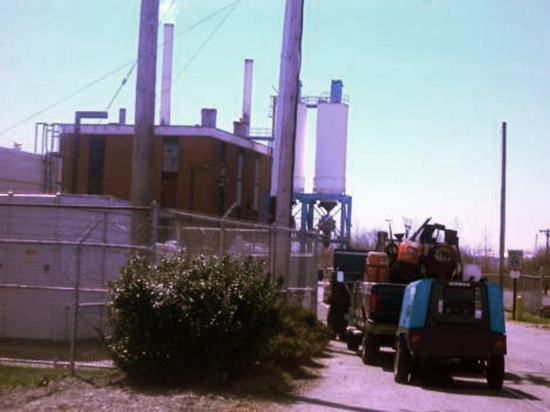
Who is the bigger air polluter – the Covanta trash incinerator, or the DELCORA sewage sludge incinerator a block away in Chester?
Some claim that Covanta is less of an issue and that people should be more focused on DELCORA. Both are a problem, but there’s no question who the larger air polluter is, as the following slides show.
Currently, the issues before us are:
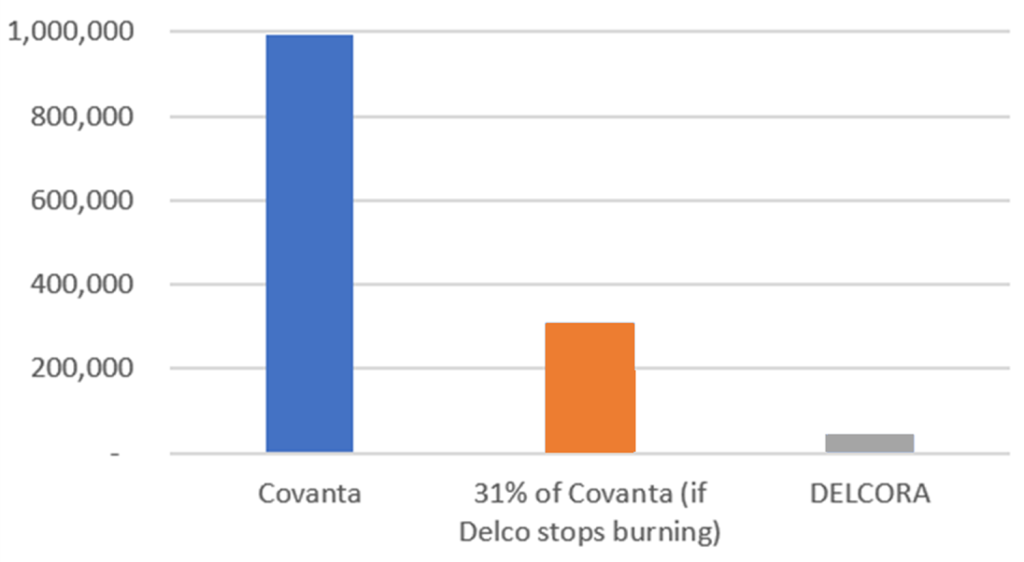
- The county continuing to feed Covanta 31% of their waste stream
- DELCORA’s privatization and a planned doubling of the sludge they burn if they start taking the eastern half of the county’s sewage
Covanta vs. DELCORA
Here is an estimate of the greenhouse gases generated by each facility in tons of CO2 equivalent [20-year impact]. Noted, also, is an estimate of how much of these gases are the result of Delco trash being sent to the incinerator.
Shifting to tons of Hydrochloric Acid, we have the following information:
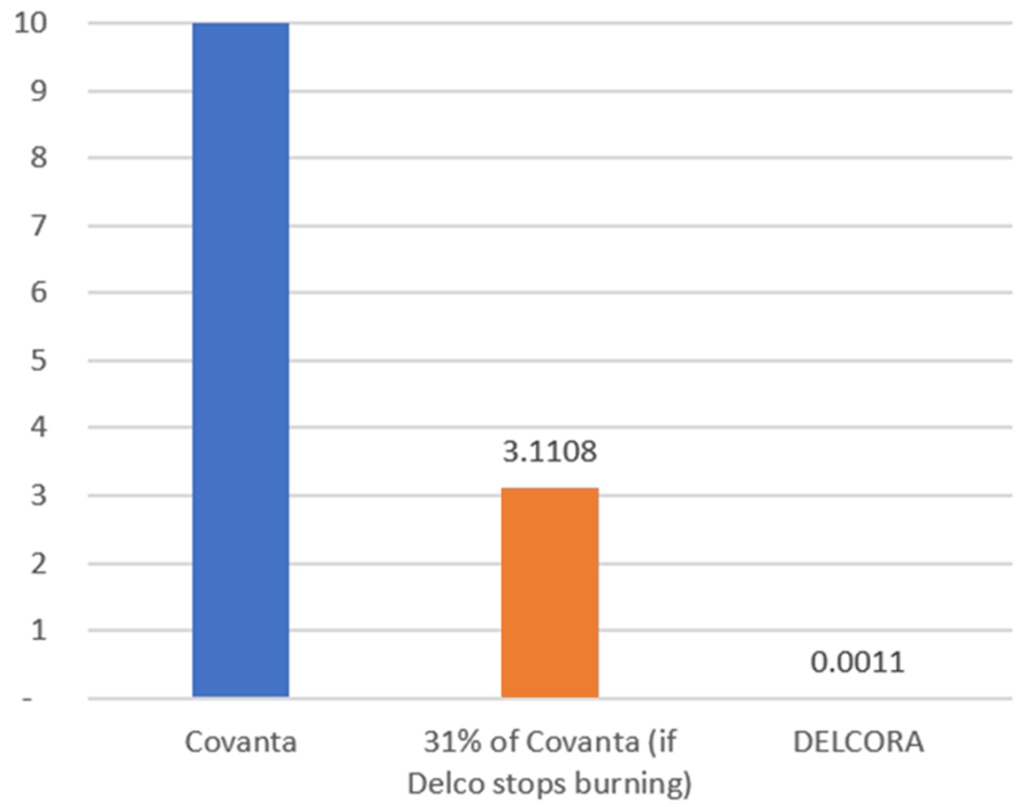
Next, for tons of Nitrogen Oxides or “NOx”, not to be confused with Nitrous Oxide (laughing gas from your dentist’s office):
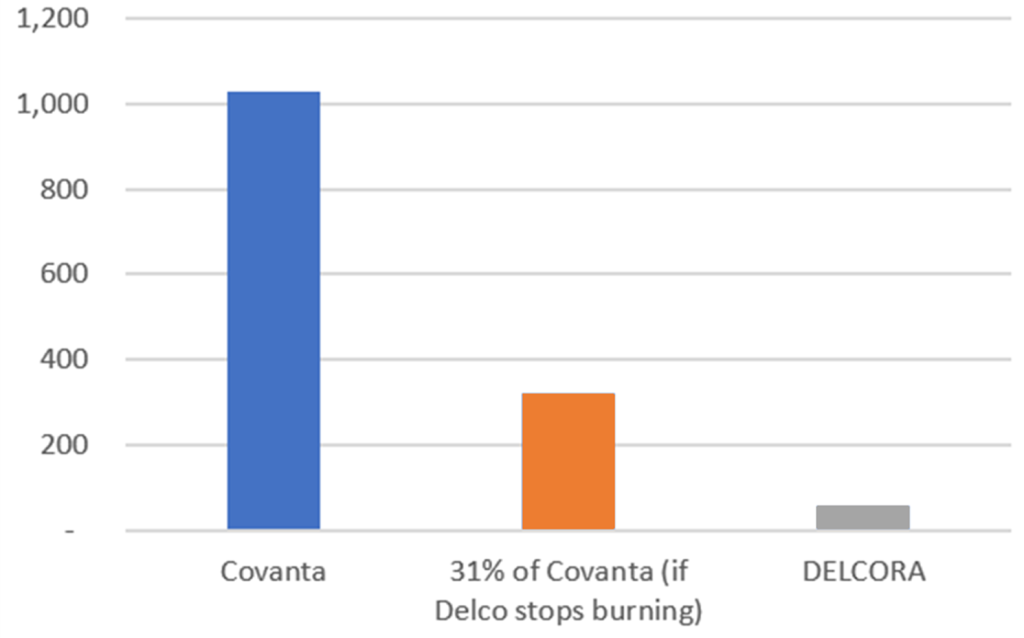
Next for tons of fine particulate matter, sulfur oxides and volatile organic compounds:
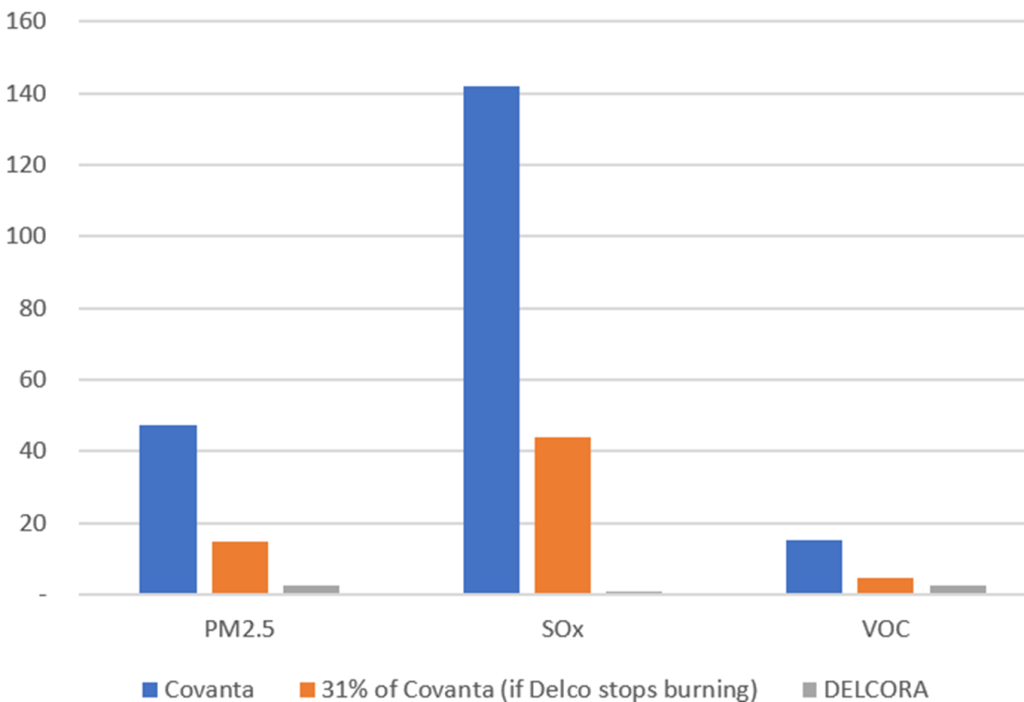
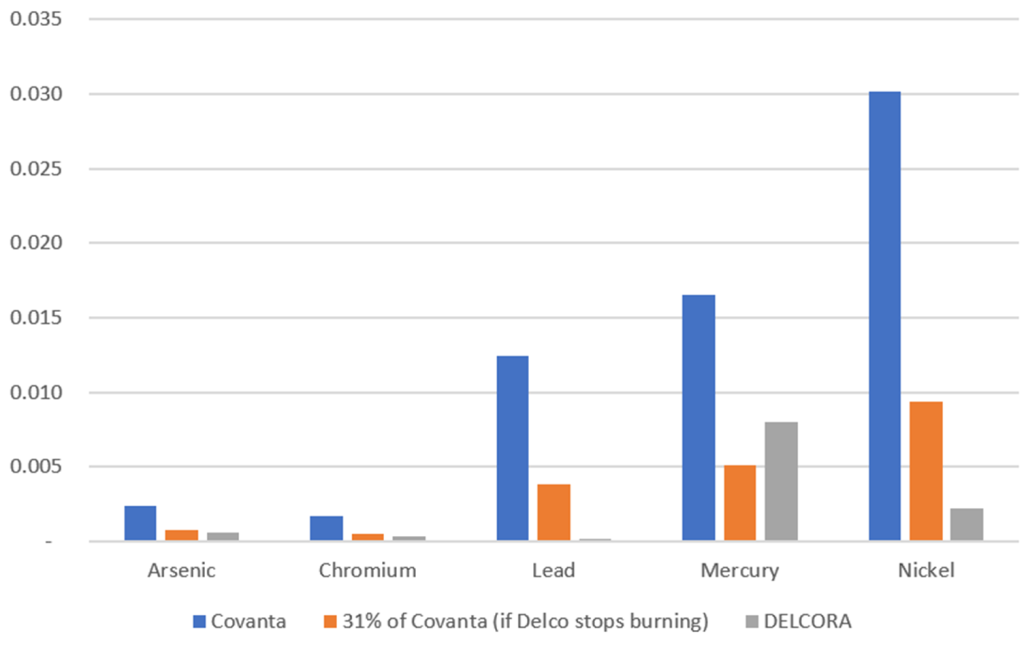
And finally for toxic metals:
Debunking Covanta’s Emissions Claims
Covanta’s Area Asset Manager, Don Cammarata says…
“99.9+% of what comes out of the stack are normal components of air, including water vapor, nitrogen, oxygen, and CO2. The remaining constituents – see table – are well below allowable limits set by State and Federal regulators that have demonstrated protection of human health and the environment”
CO2 is STILL a pollutant that causes global warming, and the “small” percentages of emissions that are air pollutants are enough to make them a top air polluter in the city, county, and region.
Read our full rebuttal at: www.delcoej.org/pdf/CovantaRebutted.pdf
The Smokestack Story
Covanta says: “We monitor continuously for all of our CEM parameters…” and claims the are below federal emissions standards, but let’s see what they AREN’T saying.
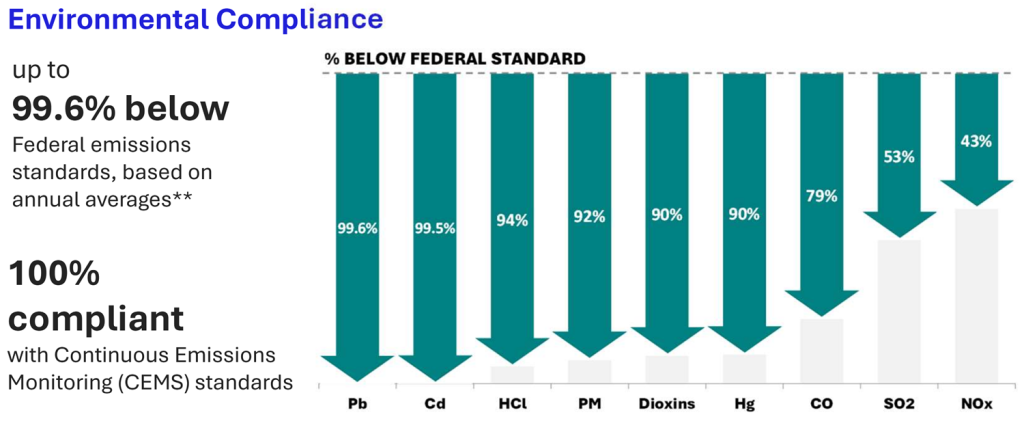
Continuous Emissions Monitors (CEMs) tell the whole story. There is rigorous enforcement by the state. Emissions limits are directly related to health & safety impacts.
- Covanta/Reworld is not always within permit limits — notice that they are averaging across years. (Fines are not enough.)
- They cannot meet modern limits, at least for NOx.
- Emissions limits are stricter for new facilities and for those in other countries.
- EPA is supposed to update standards every 5 years and hasn’t done so for 16 years now. Permit limits are not based on health and safety, but are technology-based.
- Permit limits are concentration-based. Bigger means they can be dirtier.
- A 500 ton/day incinerator would be permitted to release 7 times less than what Covanta’s 3,500 ton/day incinerator in Chester can legally emit.
- Covanta has rigged stack tests AND continuous monitoring.
- They do NOT monitor for lead, mercury, dioxins, radiation, fine particulate matter, etc. because there is no safe dose of these pollutants.
- Only 3 pollutants are monitored continuously. Emissions are underestimated when they are only tested once a year by their OWN contractor.
A Bit about Continuous Emissions Monitors
CEMS is only generally used for 3 pollutants: sulfur oxides (SOx), nitrogen oxides (NOx) and carbon monoxide (CO) plus opacity, oxygen and temperature.
- Hydrochloric acid emissions 62% higher
- Actual dioxin emissions 32-52; 460-1,290 times higher
- Technology now exists to continuously monitor:
- Ammonia (NH4)
- Carbon Dioxide (CO2)
- Hydrogen Sulfide (H2S)
- Acid Gases:
- Sulfuric Acid (H2SO4)
- Hydrofluoric Acid (HF)
- Hydrochloric Acid (HCl)
- Products of Incomplete Combustion (PICs):
- Dioxins & Furans
- Polycyclic Aromatic Hydrocarbons (PAHs)
- Volatile Organic Compounds (VOCs)
- Particulate Matter (PM)
- Metals:
- Antimony (Sb)
- Arsenic (As)
- Barium (Ba)
- Cadmium (Cd)
- Chromium (Cr)
- Lead (Pb)
- Manganese (Mn)
- Mercury (Hg)
- Silver (Ag)
- Nickel (Ni)
- Zinc (Zn)
- …and more
You can learn more about CEMs at: www.ejnet.org/toxics/cems
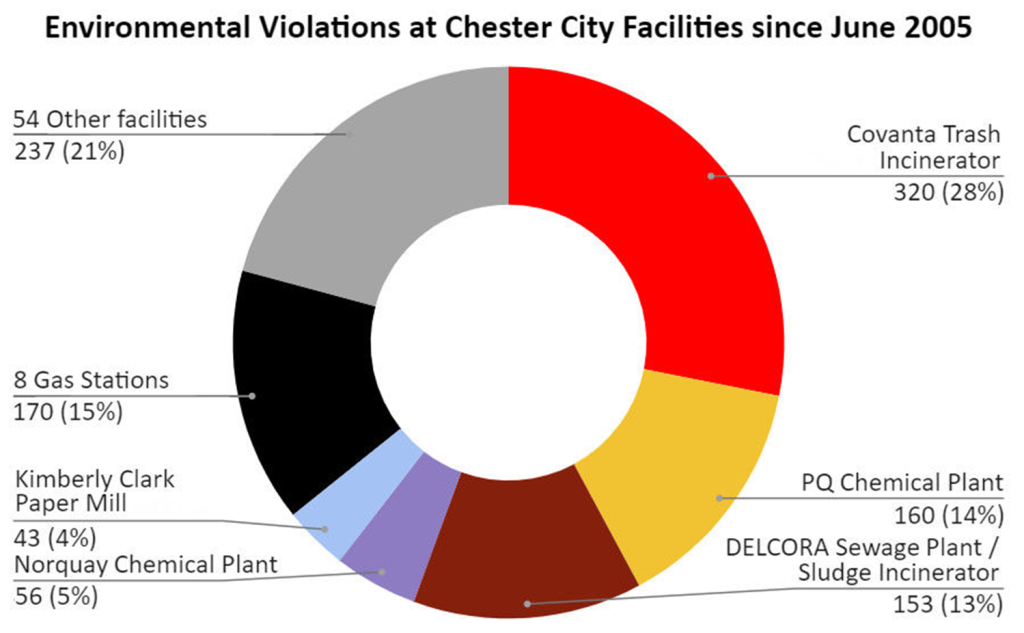
Environmental Violations at Chester City Facilities (June 2005 – August 2021)
Covanta is the leading source of violations in this time period.
State Permit Violations
Covanta’s incinerator in Chester is the 2nd worst in the state for permit violations. Covanta operates all of the state’s six trash incinerators except for the Wheelabrator Falls incinerator in Bucks County.
| Incinerator | County | Air violations since 2010 | Air violations since 2017 | ALL violations since 2017 |
|---|---|---|---|---|
| Plymouth | Montgomery | 59 | 29 | 32 |
| Chester | Delaware | 44 | 22 | 23 |
| Lancaster | Lancaster | 35 | 16 | 17 |
| York | York | 27 | 12 | 12 |
| Falls | Bucks | 10 | 4 | 7 |
| Harrisburg | Dauphin | 9 | 1 | 9 |
Source: PA Department of Environmental Protection, Environment Facility Application Compliance Tracking System (eFACTS): https://www.ahs.dep.pa.gov/eFACTSWeb/
Health Impacts
Covanta claims that health studies of communities around trash incinerators show nothing to worry about. However, they cherry pick the studies that didn’t find any connection, and it can be hard to find such connections in studies when pollutants and people move, among other factors. For references to the studies that do find a connection to the listed health impacts, see this factsheet on incinerator health studies.
Covanta says: “incinerators have been studied comprehensively for health risk”
Fact: Not much in the U.S. and not comprehensively at all.
People living near incinerators have an increased risk of…
- All types of cancer, including:
- Stomach
- Colorectal
- Liver
- Renal
- Lung & pleural
- Gallbladder
- Bladder
- Non-Hodgkin lymphoma
- Leukemia
- Soft-tissue sarcoma
- Respiratory diseases & symptoms
- Cardiovascular diseases
- Urinary diseases
Source: www.energyjustice.net/incineration/healthstudies.pdf
Childhood Asthma Hospitalization is 3 TIMES the PA Rate

For those under 18 years of age, for 2010:
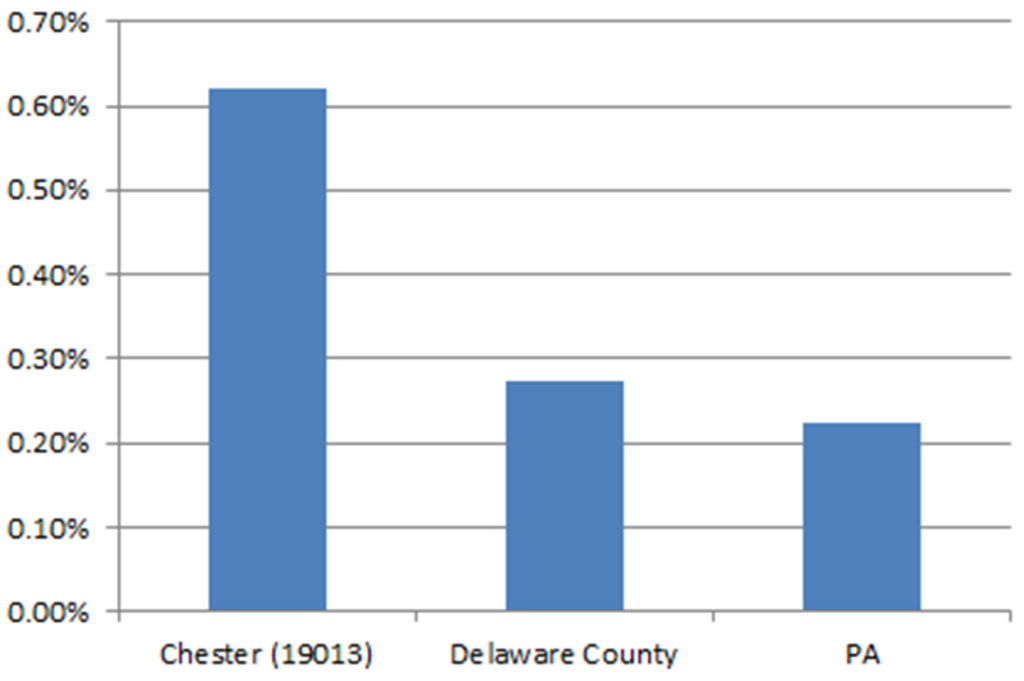
Data provided by Pennsylvania Health Care Cost Containment Council (PHC4).
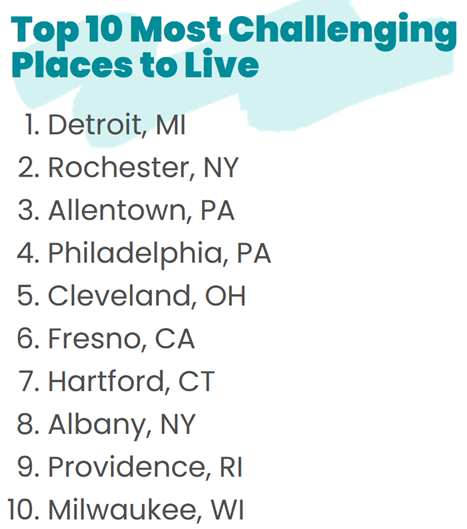
Asthma Capitals (2025 Update)
Philadelphia Metro Area ranked…
- #4 in 2018
- #4 in 2019
- #7 in 2021
- #9 in 2022
- #8 in 2023
- #5 in 2024
- #4 in 2025
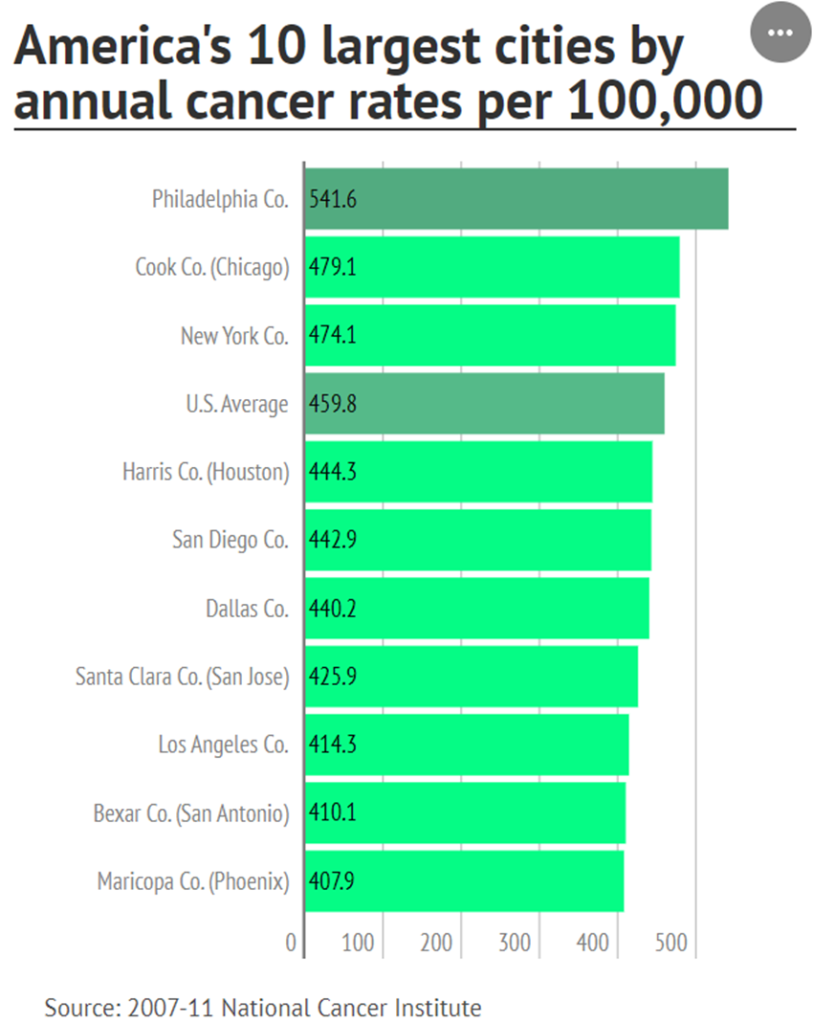
Top Cancer Cities
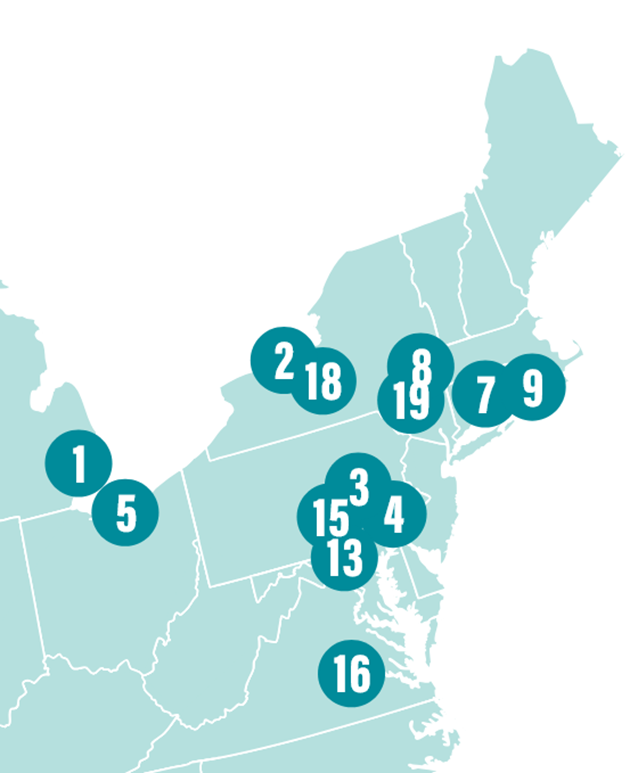
Philly is now #2 in cancer incidence among the counties hosting the 10 largest U.S. Cities
Delco’s cancer rate is worse.